


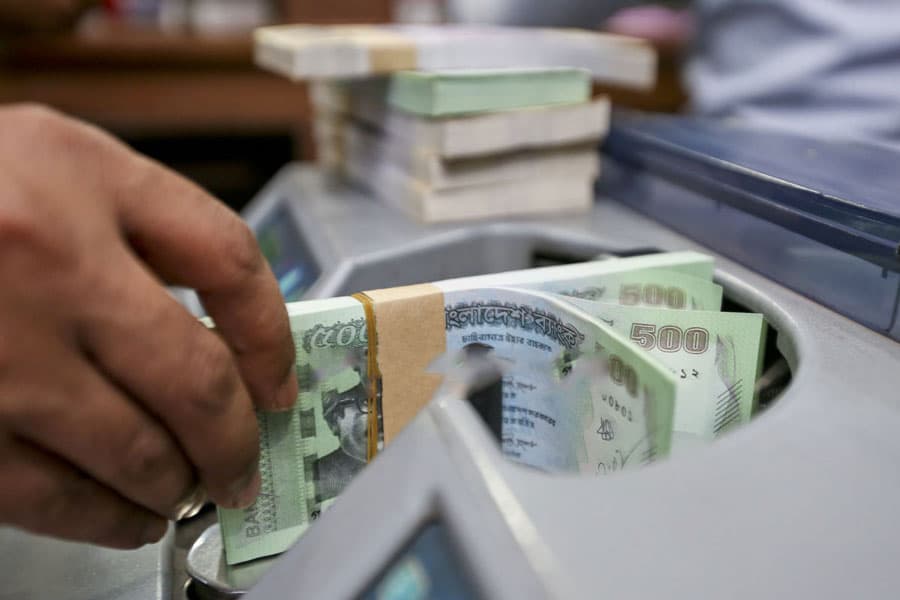
A combination of high interest rates on bank loans and shifts in the political landscape have slowed down the flow of credit to the private sector in Bangladesh.


In September, the growth rate was 9.20 percent, the lowest in three years, according to data from Bangladesh Bank.
The previous low was 8.77 per cent in September 2021. The growth rate in August was slightly higher at 9.86 per cent.
The current credit growth rate is close to the target set by the central bank, which aims to control inflation through a contractionary monetary policy. The goal for the first half of the fiscal year has been revised down to 9.80 per cent from 10 per cent.
Economists and bankers attribute the slowdown in loan growth to high interest rates, political uncertainty, and reduced demand for goods abroad. These factors have made businesses less inclined to take out loans.
Mohammad Hatem, president of the Bangladesh Knitwear Manufacturers and Exporters Association (BKMEA), said the political instability following the mass uprising that toppled the Awami League administration in July and August negatively impacted businesses, making investors wary.
“The political instability in the first two months of the fiscal year led to significant disruptions. In July alone, the garment industry lost over $1 billion due to bank closures, affecting imports and exports. After such losses, businesses are understandably reluctant to invest further,” Hatem said.
“After two consecutive months of economic strain, businesses reevaluated the situation. As demand had dropped, there was no need to seek bank loans.”
Hatem’s observations are borne out by central bank data, which show a decrease in the issuance and settlements of Letters of Credit (LCs) for imports during the first quarter of the fiscal year (July-September). This has been the case despite ample dollar reserves in banks, according to Bangladesh Bank Governor Ahsan H Mansur and several banking officials.
Compared to the same period last year, LC openings dropped by 8.58 per cent, and settlements declined by 17.57 per cent.
In the first quarter of FY25, the total value of LCs opened was $1.559 billion, with settlements amounting to $1.671 billion. Import of capital machinery saw a sharp decline of over 41 per cent, dropping to $380 million from $650 million during the same period in 2023.
Syed Moazzam Hossain, president of the Australia-Bangladesh Chamber of Commerce and Industry (ABCCI), pointed out that high interest rates and political uncertainty have dampened business investment, leading to a reduced demand for loans.
“The interest rate on bank loans has climbed to 15 per cent, raising the overall borrowing costs for businesses. This has made funding more expensive, and demand for loans has declined. Businesses are reluctant to operate at a loss, so they are borrowing less,” he said.
“Loan demand will pick up only if interest rates decrease. Although businesses are still taking out loans, the volume has gone down. The high borrowing costs mean that companies now have to carefully evaluate their ability to repay loans before making any investment decisions. This cautious approach is limiting new investments.
”On Oct 22, Bangladesh Bank raised the repo rate, the interest rate at which the central bank lends money to commercial banks, by 50 basis points to 10 per cent in a bid to tackle inflation. Higher policy rates usually lead to higher interest rates on loans as the central bank aims to reduce the money supply.
Since taking office, Mansur has increased the policy rate three times, causing bank loan interest rates to reach up to 15 per cent. By comparison, deposit rates range between 8 per cent and 11 per cent, with some banks offering up to 12 per cent to attract more deposits.
Hossain also highlighted gas supply shortages to factories as another factor disrupting production and slowing down investment.
Syed Mahbubur Rahman, managing director of Mutual Trust Bank Limited (MTB), noted that high interest rates and the instability caused by the July-August movement have led to a decline in private sector borrowing.
With rising inflation driving up costs, businesses that previously benefited from lower-interest loans now find them unaffordable.
“The political turmoil has hurt investment prospects, and higher interest rates have made businesses more hesitant to take out loans.”
Speaking to business outlet Share Biz, Rahman further pointed out that the political uncertainty has created instability in the business environment. In such circumstances, entrepreneurs tend to hold off on investments, leading to reduced loan growth, he explained.
Additionally, lower import volumes and weak export growth have further impacted borrowing, according to him.
In early 2022, private sector credit growth was above 10 per cent, even peaking at 14 per cent at one point.
However, as inflation surged, the central bank raised policy interest rates to manage it. The shift towards monetary tightening has caused loan growth to decline steadily since mid-2023, now dropping to around 9 per cent.